A buyer’s roundup of the best Roomba models compares performance, features, and total ownership costs to help shoppers decide. Smart households with pets, thick carpets, or tight budgets face clear tradeoffs between suction, obstacle avoidance, and recurring dock consumables. A self-empty base automatically transfers debris from the robot’s dustbin into a sealed dock bag for less frequent manual emptying. You will walk away with ranked model picks, clear tradeoffs, and concrete cost estimates to match models to real homes and budgets.
Coverage includes ranked picks for j9+, j7, and s9+, obstacle-avoidance testing, AutoEmpty dock tradeoffs, and vacuum and mop Combo comparisons. A downloadable comparison workbook, a TCO checklist for consumables, and quick setup and maintenance notes are included so buyers can compare models side by side.
Homeowners, renters, parents, and pet owners get targeted recommendations based on shedding level, carpet pile, and room layout. For example, a two-dog household that tested the j9+ reduced manual emptying from weekly to monthly while improving hair pickup. Use these tested picks and cost models to choose the right Roomba for your space and budget.
Roomba Models Key Takeaways
- Roomba j9+ ranks best overall for pets, suction, obstacle avoidance, and AutoEmpty compatibility.
- Roomba j7+ offers top-tier obstacle avoidance at a lower price.
- Roomba s9+ delivers the strongest deep-pile carpet suction among current Roomba models.
- Roomba i5+ balances AutoEmpty convenience and midrange performance for mixed-floor homes and budgets.
- Combo j9+ pairs strong vacuuming with mopping and smart maps for hands-off cleaning.
- AutoEmpty docks reduce manual emptying but add recurring bag and filter costs.
- Compare total cost of ownership across consumables, replacement cadence, warranty, repair reserve, and trade-in value.
Which Roomba Models Rank Highest For Best Roomba Model?
Roomba j9+ is our Best Overall pick. It pairs powerful suction, standout obstacle avoidance, reliable smart mapping, and an AutoEmpty dock.
The ranked top picks are listed below:
- Roomba j9+ (Best Overall)
- Roomba j7
- Roomba j7+
- Roomba i5+
- Roomba i3 (i3+ EVO)
- Roomba s9+
- Roomba s9
- Combo j9+ (vacuum + mop)
- Combo j7+
- Combo i5+
- Other Roombas worth considering for niche needs
We evaluated models on practical performance and ownership costs. The ranking criteria included:
- Powerful suction for deep carpet cleaning
- Obstacle avoidance for cluttered or pet-filled homes
- Smart mapping for reliable room coverage
- Self-emptying base convenience and AutoEmpty dock compatibility
- Total Cost of Ownership (TCO) including replacement bags and filters
Auto-empty systems reduce how often you hand-empty the bin while adding recurring bag and filter costs. Weigh convenience against consumable spend by comparing expected emptying frequency and replacement prices:
- Fewer manual empty cycles
- Ongoing bag and filter expenses
Match the model to the use case:
- Pet owners/heavy hair: Roomba j9+ or Roomba j7+
- Tight or cluttered homes: Roomba j9+ or Roomba j7
- Budget with self-emptying: i5+ or i3+ EVO
- Deep-carpet cleaning: Roomba s9+ or Roomba s9
- Mop+vacuum shoppers: Combo j9+ or Combo i5+
iRobot’s Trade-In Program can lower your upgrade cost with an estimated trade value, sending your old unit, condition verification, and credit applied to your purchase.
1. Roomba j9+ — Best Overall For Pets And Obstacles
The Roomba j9+ is our top overall pick because it pairs industry-leading suction with reliable obstacle avoidance and a self-emptying base for homes with pets or deep-pile carpet.
Key strengths:
- Suction and pet performance: PCMag’s Editors’ Choice named the j9+ for suction. It produces the strongest airflow in the j series and lifts embedded pet hair and dander from carpets.
- PrecisionVision obstacle avoidance: PrecisionVision uses artificial intelligence (AI) to spot and steer around cords, shoes, and pet messes. That reduces interruptions and manual cleanup.
- Self-emptying convenience: Roomba j9+ and Combo j9+ include a self-emptying base. That saves time for busy households and lowers allergen exposure.
- Value cue: Typical deal pricing appears around $619 at Walmart. Budget for replacement bags and brushes when you buy.
If Roomba carpet performance and worry-free pet hair cleaning matter most, you should choose the j9+. Check current deals and accessories via our affiliate link.
2. Roomba j7 — Best Budget Obstacle Avoidance
The Roomba j7 brings iRobot’s hazard-recognition cameras and PrecisionVision navigation to a lower price point. It provides reliable obstacle avoidance. The model skips the self-emptying base found on higher-end units.
Common household hazards it detects and avoids:
- Power cords and charging cables
- Pet bowls and low toys
- Pet waste and other soft hazards
The j7 lacks a self-emptying dock. iRobot offers the P.O.O.P. guarantee on the Roomba j7+.
You can save most of those detection features by buying during sales. iRobot’s j7+ Combo discounts have dropped to $699 from $1,100.
For pet households, the j7 handles pet hair cleaning affordably for these reasons:
- Fewer messy encounters and manual cleanups
- Reduced tangles around brushes and wheels
- Lower entry cost that scales for multi-pet homes
If you want full hands-off emptying or advanced mapping for very cluttered homes, choose a premium model.
3. Roomba j7+ — Best Self Emptying For Pet Owners
If pet hair and surprise accidents are your top headaches, the Roomba j7+ makes self-emptying actually useful.
The j7+ includes a self-emptying base. You rarely touch hairballs after walks or during heavy shed season. That lowers day-to-day maintenance compared with non-emptying models.
The j7+ uses vision-guided hazard detection to spot and steer around pet waste, toys, and other hazards. iRobot’s P.O.O.P. guarantee supports qualified incidents.
Mapping and scheduled cleanings let you target high-hair areas without extra work:
- Send the j7+ to the couch or kennel.
- Schedule short, frequent passes for pet zones.
- Let the base hold days of debris so you empty the bin less often.
Other iRobot models like the j9+ also include auto-empty bases. The j7+ stands out for pet owners because its hazard recognition avoids messes and cuts cleanup. That combination makes it the low-effort choice for homes with pets.
Read more at the Roomba j7+ Review.
4. Roomba i5+ (i5 Plus) — Best Midrange Self Emptying Value
Hands-off cleaning and fewer upkeep chores are the main gains with the Roomba i5+.
It is a mid-range robot vacuum that pairs an auto-empty base with reliable suction and smart scheduling at a lower price than Roomba’s j-series models.
Auto-empty bases provide weeks-long bin collection.
- The Clean Base used with the Roomba i3+ EVO holds roughly 60 days of debris.
- The i5+ provides the same weeks-long collection so you empty the bin far less often.
For price and performance context:
- Some listings show the Roomba i3+ EVO with Clean Base around $297.95, and the i5+ adds stronger navigation and suction than budget self-emptying options while remaining cheaper than j7+ or j9+ models.
The i5+ fits mixed-floor homes because it offers:
- Adaptive brushes that handle hardwood, tile, and low-to-medium pile carpet
- Consistent edge cleaning that picks up along baseboards
- Flexible scheduling for regular, hands-off upkeep
Pick the i5+ when you want the time savings of an auto-empty base without premium obstacle-avoidance features.
For budget-conscious pet owners and families who need steady mixed-floor cleaning, the i5+ is the practical choice.
5. Roomba i3 (i3+ EVO) — Best Affordable Self Emptying Option
If you want AutoEmpty on a budget, the Roomba i3+ EVO gives hands-off debris management without premium frills.
Key specs and practical takeaways:
- Runtime: about 90 minutes on a full charge, based on our reference testing and competitor data.
- Base capacity: the Clean Base holds roughly 60 days of debris.
- Price/value: typically sells for about $297.95 on an Amazon listing, price accurate as of April 2026.
The i5+ offers more advanced mapping. The Roomba i3+ EVO delivers nearly the same AutoEmpty convenience at a lower sticker price, which makes it a better choice if you want self-emptying without extra navigation features.
Some rivals advertise up to 75 days of storage and LiDAR navigation. The i3+ EVO trades that extra storage margin and high-end navigation for a lower price and dependable day-to-day performance.
6. Roomba s9+ — Most Powerful Deep Carpet Suction
If deep-cleaning thick carpet is your top priority, choose the Roomba s9+.
It’s iRobot’s flagship for powerful suction and a clear benchmark for deep-pile pickup.
That powerful suction comes from a high-torque motor.
An airflow-focused brush system directs lift into the carpet to remove embedded pet hair and dense fibers more effectively than midrange models.
The D-shaped chassis has a flat front and angled edges.
That shape lets the robot reach corners and baseboards that round robots often miss, so edges and carpet seams pick up more dirt.
Reviewer and lab tests consistently report stronger carpet pickup for pet hair and tracked-in grit, which helps justify the higher price for carpet-first homes.
Consider these tradeoffs:
- Higher price than many competitors and some newer iRobot models.
- Larger Clean Base and docking footprint compared with simpler vacuums.
- Weaker value if most floors are hard or you’re on a strict budget.
Pick the s9+ when heavy pet shedding or dense carpets make suction the deciding factor.
7. Roomba s9 — Powerful Carpet Cleaner Without Base
For carpet-first homes, the Roomba s9 delivers flagship suction without the self-empty dock.
It uses the same D-shaped chassis and powerful motor as the s9+.
That setup pulls debris deep from carpet and improves corner cleaning.
Without an auto-empty base, the s9 has a smaller on-board bin and requires more hands-on upkeep.
Expect to empty the bin after heavy runs, especially with pets or long-pile carpet.
Plan on more frequent filter and brush cleaning than with the s9+.
Like the s9+, the s9 emphasizes suction and edge cleaning.
It lacks a front-facing obstacle-avoidance camera, so it is less suited to pet-waste avoidance or very cluttered rooms.
Consider these buyer scenarios:
- Carpet-first households prioritizing deep cleaning and corner pickup
- Buyers who want flagship suction but prefer to avoid the dock’s up-front cost and footprint
- Buyers who need fewer manual empties per week should choose the s9+ instead
If you accept more frequent maintenance, the s9 balances top-tier carpet performance with a lower purchase price.
8. Roomba Combo j9+ — Best Premium Vacuum And Mop Combo
The Roomba Combo j9+ is the best premium vacuum-and-mop combo because it pairs strong suction and reliable multi-surface cleaning with smart mapping and iRobot’s PrecisionVision navigation.
It delivers class-leading vacuum power for a combo unit and outperforms budget 2-in-1 mopping and vacuuming rivals on pickup and edge cleaning.
Key real-world advantages:
- Cleans baseboards and edges more thoroughly than most combo models
- Lifts debris from low- to medium-pile area rugs without repeated passes
- Handles transitions between hard floors and rugs without swapping machines
Stored smart maps keep routes consistent and help the mop cover more area with fewer misses.
Mapping features include:
- Saved room maps for targeted room-by-room cleaning
- No-mop zones to protect rugs, pet beds, or sensitive floors
- Consistent routes for reliable vacuum+mop runs over time
iRobot’s Roomba Combo 10 Max ships with an AutoWash Dock and has an MSRP of $1,399.99. You should prioritize an AutoWash Dock if hands-off mop cleaning matters, and confirm whether a j9+ bundle includes that dock before you buy.
Combo robots trade off deep-pile carpet suction against dedicated vacuums like iRobot’s Roomba s9+, so choose the j9+ when you want reliable vacuuming and practical mopping in a single premium machine.Read the full review of the Roomba Combo j9+.
9. Roomba Combo j7+ — Best Combo For Obstacle Avoidance
If obstacle avoidance is your top priority, the Roomba Combo j7+ is the best combo for mixed homes.
The j7-series hazard-recognition cameras and PrecisionVision Navigation actively spot and steer around common obstacles, including pet waste.
Core features:
- Hazard-recognition cameras that detect and avoid small objects and pet waste
- PrecisionVision Navigation for targeted steering around hazards
- Integrated vacuum-and-mop system for one-pass hard-floor cleaning
Like other j7+ models, the Combo j7+ supports an optional self-emptying base.
The j9+ and Combo j9+ from iRobot also use self-emptying bases.
Self-empty benefits:
- Reduces how often you handle dust and debris
- Especially useful for households with pets
- Available as an add-on rather than mandatory equipment
Quick performance snapshot:
- Obstacle avoidance: excellent for small objects and pet waste
- Hard-floor cleaning and mopping: strong and convenient in one pass
- Deep-carpet suction: typically lower than non-combo high-suction models
Street pricing has been discounted to about $699 from roughly $1,100 as of April 2026, which improves value if you need both mopping and reliable hazard avoidance.
Choose the Combo j7+ when pet-waste avoidance, mop capability, and an optional self-empty base matter most; choose a non-combo higher-suction model only if deep carpet cleaning is your top priority.
10. Roomba Combo i5+ — Best Midrange Combo For Mixed Floors
Roomba Combo i5+ hits a balance between hands-off dust disposal, useful mopping for hard floors, and mid-range pricing.
It sits between the budget i3+ EVO and the Roomba Combo 10 Max at $799.99.
The i5+ uses a Clean Base style dock to cut manual emptying to multi-week intervals.
The i3+ EVO’s Clean Base provides multi-week debris storage.
The i3+ EVO’s robot runtime tested at 90 minutes.
The Combo i5+ is a practical 2-in-1 mopping and vacuuming solution for mixed floors.
The mop module is tuned for light soil and sticky spots on tile and wood.
A dedicated vacuum still outperforms on deep-pile carpet.
The i5+ handles daily debris on low-to-medium pile rugs.
Key practical features to expect:
- Smart scheduling and room-by-room mapping for targeted cleanups
- Reliable suction with multi-surface brushes
- Self-empty Clean Base style dock for fewer manual emptyings
Choose the i5+ if your home is mostly hard floors with area rugs or low-pile carpet.
Consider the Roomba Combo Essential as a lower-cost 2-in-1 option.
Pick a premium combo only if you need heavy, frequent mopping or advanced mop-cleaning features.
11. Other Roombas Worth Considering — Quick Notes On Minor Picks
Compact Roombas can solve specific cleaning needs without paying for flagship extras.
Quick notes with one-line strengths and best buyer fits:
- Roomba Combo j5: Reliable vacuum-plus-mop convenience with good obstacle sensing. Best for busy pet owners who need a compact combo for daily hair and light mopping.
- Roomba Combo 10 Max: Premium vacuum and mop with top suction and an AutoWash Dock that cleans the mop automatically. Listed at $799.99, it suits owners who want near‑hands‑free mop maintenance and maximum cleaning power.
- Roomba Combo Essential: Simple, no‑frills cleaning at an entry-level price point. Best for renters or budget-minded buyers who want dependable day-to-day pickup without smart extras.
- Roomba Max 705: Strong midrange suction and value with retail examples at $599.99 and previous listings near $899.99 (save about $300). Best for carpeted homes that need higher power without combo features.
- Roomba 205 DustCompactor: Compact, dust-focused design for small spaces and frequent dust containment. Best for small-flat dwellers who prioritize space-saving and tidy dust management.
If lowest upfront cost is your priority, consider a budget Roomba like the 2025 Roomba 105 Vac. iRobot released the Roomba Plus 505 Combo in early 2025 with an AutoWash dock for hands-free mop care.
How Do Trade In And Recycling Options Affect Which Model You Should Buy?
Trade-in and recycling options change the net price you pay for a new Roomba. Using the iRobot trade-in program as a canonical example makes planning that net cost straightforward.
The typical flow is simple:
- Get an online estimate based on model and condition.
- Ship the old robot using the prepaid label.
- Receive a trade credit applied at checkout.
Two eligibility buckets affect your net price:
- Same-brand units usually qualify for credit.
- Third-party vacuums and non-qualifying robots must be recycled or donated and give no credit.
To get an accurate estimate, identify model and serial number on the robot:
- Turn the robot over and read the model near the left wheel.
- Remove the dust bin to reveal the serial printed in the bin cavity.
Simple math clarifies choices:
- $499 − $150 trade credit = $349 net
- $499 − $0 credit (recycle/donate) = $499 net
Check your local recycling program, resale marketplaces, and charity donation rules to balance timing, cash recovery, and tax considerations before you buy.
How Do You Compare Total Cost Of Ownership By Model?
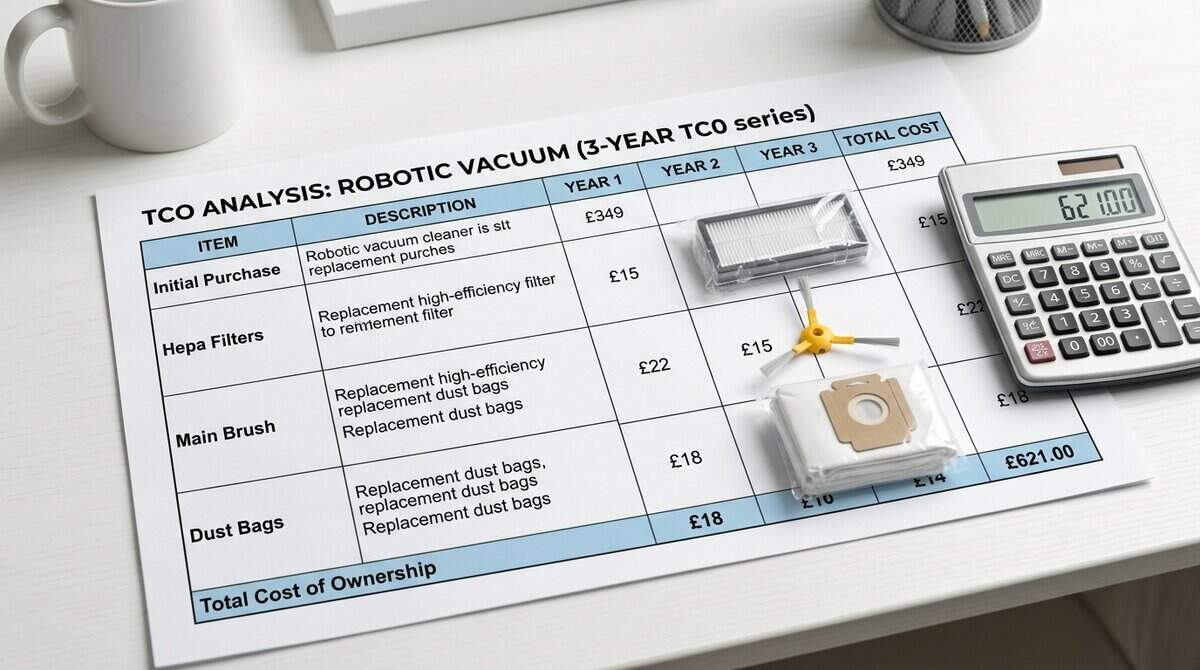
Comparing total cost of ownership (TCO) helps you pick the Roomba model that fits your home’s needs and long-term budget.
Use this TCO checklist to score models side by side:
- Consumables: HEPA and foam filters, mop pads, AutoEmpty dock bags and dock filters.
- Replacement cadence: filter intervals in months, brush and bearing lifecycles in years, mop‑pad and bag frequency.
- Mechanical wear: roller and rubber brush replacement and bearing risk.
- Warranty and repair exposure: warranty length and typical repair probability.
- Utility use for combos: extra water and electricity for vacuum‑mop hybrids.
Typical replacement windows and an annualized example:
- HEPA/foam filters: 3-12 months.
- Rubber/roller brushes: 1-2 years.
- Worked example annualization: filters $40/year, brush prorated $20/year, combined consumables ≈ $60/year.
A self-empty dock reduces manual emptying and increases ongoing consumable costs.
- Annual dock consumables: $60–$180 per year depending on usage and dock model.
- Tradeoff: less emptying time vs. ongoing bag/filter expense.
Account for warranty length and reliability by annualizing repair exposure:
- Annual repair reserve estimate: $0–$100/year.
- Combine reserve plus consumables to calculate annual and multi-year totals.
Side-by-side annual totals for three scenarios:
Scenario | Annual consumables + repair | 3‑year total | 5‑year total |
|---|---|---|---|
Base model | $110 | $330 | $550 |
AutoEmpty dock model | $230 | $690 | $1,150 |
Vacuum‑mop combo | $190 | $570 | $950 |
Factor in trade-in credit tiers and a recycling program when calculating net ROI over 3–5 years to determine which model truly saves you money.
How Would A Personalized Decision Toolkit Narrow Your Roomba Options?
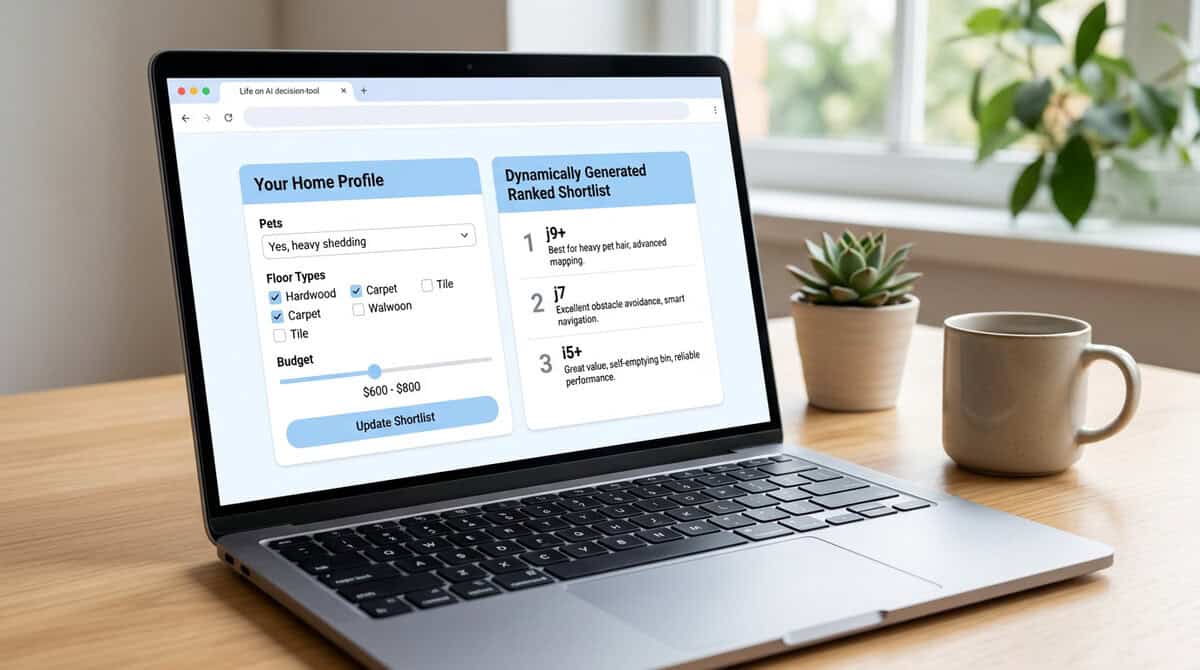
A personalized decision toolkit turns your home priorities into a short, ranked shortlist of Roomba models so you can choose more quickly.
The questionnaire asks about these priorities:
- Pets: type and shedding level to estimate filter and brush wear.
- Floor types: carpet pile versus hard floors to judge suction needs and smart mapping performance.
- Household: kids, allergy concerns, and crumb frequency to set emptying cadence.
- Layout: single floor or multi‑floor and whether LiDAR navigation is preferred for precise room mapping.
- Features and budget: mop combo, self‑empty, and price limits to weight value appropriately.
Answers map to weighted decision factors and produce ranked recommendations for iRobot j9+, j7, i5+, and s9+. The toolkit recalculates when deals change and shows value shifts:
- Enter an estimated trade‑in value or select retailer promotions.
- See updated out‑the‑door totals and reordered model ranks.
- View scenarios such as a $150 trade‑in moving a j7+ above an i5+.
The downloadable comparison workbook exports editable results and cost modeling with these columns:
- Ranked results plus local deal and trade‑in fields
- 3‑year Total Cost of Ownership listing consumables, expected repairs, and electricity or water for mop models
- Excel and Google Sheets formats for local edits
A built‑in KPI calculator exports model targets and ROI snapshots and uses filterable hardware context like the iRobot Roomba Plus 505 Combo (released early 2025) with its AutoWash Dock and RTINGS’ 90‑unit baseline to set realistic expectations. Use the workbook with your local deals to see the final ranked recommendation.
Best Roomba Model FAQs
These FAQs collect the most common questions about choosing the best Roomba model, including pet-friendly options, carpet performance, mopping compatibility, and self-emptying bases.
This buying guide helps you compare features, price, and setup so you can narrow choices and pick the right model for your home.
1. Which Roomba has the longest warranty coverage?
Most Roombas, including flagship models like the j9+ and s9+, carry iRobot’s standard one-year limited manufacturer warranty. A specific model rarely has a longer factory term, whether you’re looking at a j9+, s9+, or an i5.
Check the fine print for these details:
- Battery coverage versus robot-body coverage
- Exclusions for wear items such as filters and brushes
- Whether warranty registration is required
- Reduced terms for open-box or refurbished units
- Typical claims and repair turnaround expectations
Compare the combined manufacturer warranty and any retailer plan prices to judge which model offers the best long-term protection.
2. Which Roomba models get firmware updates longest?
iRobot typically supports its premium Roomba lines longer with firmware updates and feature rollouts. Models that tend to receive the longest support are the Roomba j9+, j7 and j7+, s9 and s9+, and recent Combo models such as Combo j9+, Combo j7+, and Combo i5+.
If you have pets, cluttered rooms, or a complex smart‑home setup with a Roomba, favor a j‑series or s9+ to get the longest practical firmware support and the best navigation, smart‑mapping, and obstacle‑avoidance refinements.
3. Which Roomba is quietest during operation?
The quietest Roombas operate around 55–62 dB, roughly library to mild‑conversation level. If you need low sound for an apartment or night cleaning, midrange iRobot Roomba i3/i5 models in Eco or Quiet mode and some j-series cycles are the best balance. Lower noise usually means reduced peak suction or longer passes, so the 2025 iRobot Roomba 105 (A13) is comparably quiet and affordable but gives up the deep-pile power of the iRobot Roomba s9/s9+.
Typical operating ranges:
- Quiet/midrange: 55–62 dB — i3/i5 in Eco/Quiet mode and some j-series
- Normal: 60–66 dB — j7/j7+ and i-series in standard mode
- Heavy-duty: 68–72 dB — iRobot Roomba s9/s9+ during deep-suction passes
- Entry-level: ~58–62 dB — lower suction and longer run times
4. Which Roomba model is easiest to maintain?
Roomba models with auto-empty bases are the easiest to maintain. The dock collects multiple cleaning cycles of debris into a sealed disposable bag or internal bin, so you empty the bin far less often and face less odor exposure. Plus variants such as j9+, j7+, i5+/i3+, and s9+ use replaceable dust bags, user-replaceable filters, and brush modules that slide out without tools, making routine upkeep swapping the bag, rinsing or tapping a washable filter, and snapping brushes back in. For pet homes favor j9+ or i5+, for a budget low-effort option choose i3 or i3+, and iRobot groups models into families (i1–i8, s9/j7/j9, Combo variants) to help you match a model to a + base when shopping.
5. Which Roomba integrates best with smart homes?
Premium Roombas such as the j9+ and s9+ integrate best with smart homes. They pair advanced navigation with richer app and ecosystem features that many users find worth the higher price.
Key smart-home integrations:
- Cloud-synced Smart Mapping that lets you name rooms, set no-go zones, and schedule room-specific cleans so you can target where the robot works.
- Voice assistant support for Amazon Alexa and Google Assistant for start, stop, and room-clean commands, with iRobot listing built-in compatibility.
- Auto-Empty Dock compatibility, remote scheduling, and vacuum-plus-mop controls on Combo or higher i-series models.
- Choose j9+ for obstacle-aware, pet-heavy homes. Choose s9+ if you prioritize maximum deep-cleaning power.